AI is no longer just about chatbots.
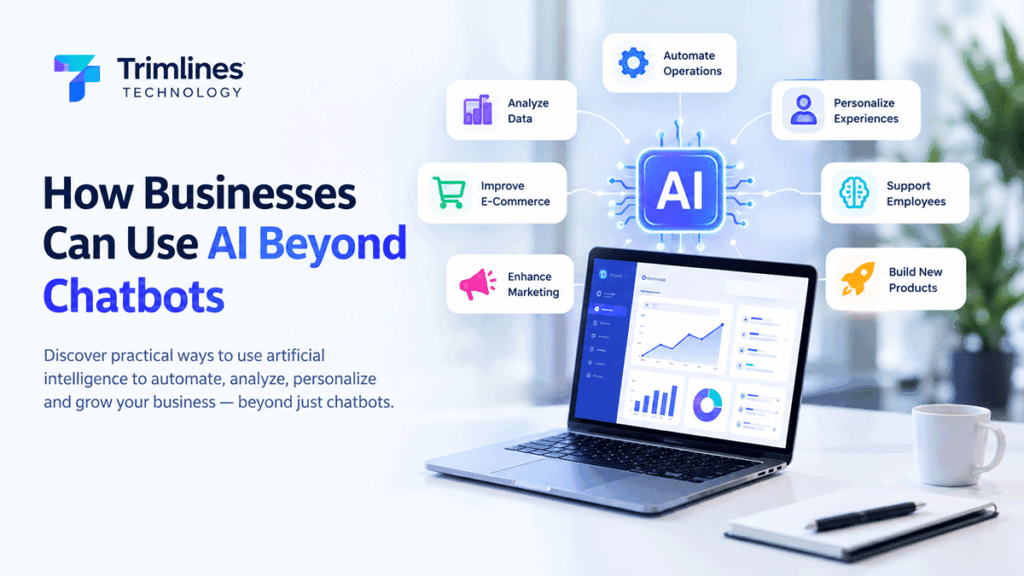
Businesses can now use artificial intelligence to automate repetitive processes, analyze business data, personalize customer experiences, improve decision-making, streamline operations, and build entirely new digital products.
For many businesses, the first introduction to AI is a chatbot. A customer visits a website, asks a question, and an AI assistant provides an answer. While this is useful, it represents only a small part of what AI can do.
The real business opportunity is to identify where intelligence, automation, and data can improve the way your organization operates.
In this article, we explore practical ways businesses can use AI beyond chatbots and how companies can start turning AI from a buzzword into a useful business tool.
What Does AI Beyond Chatbots Mean?
AI beyond chatbots means using artificial intelligence inside the actual processes, systems, and products that run a business.
Instead of simply asking:
“Can we add an AI chatbot to our website?”
Businesses should be asking:
“Where can AI make our business faster, smarter, more efficient, or more valuable?”
AI can be integrated into existing software, e-commerce platforms, mobile applications, internal business systems, marketing workflows, and customer-facing products.
For example, an online store could use AI to recommend products, identify customer buying patterns, generate product descriptions, assist shoppers, and automatically segment customers for marketing.
A property company could use AI to match customers with suitable properties.
A school could use AI to organize educational content and provide personalized learning assistance.
A healthcare organization could use AI to help organize information and automate administrative workflows, subject to appropriate privacy and professional safeguards.
The possibilities extend far beyond a chat window.
1. AI-Powered Business Automation
One of the most practical uses of AI is automating repetitive business processes.
Many organizations still spend hours performing tasks that follow predictable patterns:
- Entering information into systems
- Sorting documents
- Processing enquiries
- Categorizing customers
- Preparing reports
- Sending follow-up messages
- Extracting information from documents
- Updating records
- Routing requests to the right department
AI can help automate parts of these workflows.
For example:
Customer enquiry → AI identifies intent → system categorizes enquiry → information is stored → appropriate team receives notification → customer receives an initial response.
Instead of employees manually handling every step, AI can handle the repetitive parts while employees focus on tasks requiring human judgment.
Businesses looking to automate these types of workflows can explore our AI Solutions & Automation services.
2. AI for E-Commerce
E-commerce is another area where AI can go far beyond a traditional chatbot.
An AI-powered online store can understand what customers are looking for and help them discover suitable products.
For example, instead of searching for:
“black shoes size 42”
A customer might ask:
“I need comfortable black shoes for work that cost less than ₦100,000.”
An AI shopping assistant can interpret the request, search the store’s available products, compare relevant options, and guide the customer toward a purchase.
AI can also help with:
Product Recommendations
Recommend products based on customer behaviour, purchase history, preferences, or the products currently being viewed.
Product Discovery
Allow customers to describe what they need naturally instead of requiring them to know the exact product name.
Product Comparison
AI can explain differences between products and help customers understand which features matter.
Personalized Shopping
Different customers can receive different recommendations based on their interests and previous interactions.
Merchandising
AI can help businesses identify products that are performing well, products that may need additional promotion, and patterns in customer behaviour.
This makes AI particularly interesting for businesses that already operate online stores and want to turn their existing e-commerce systems into more intelligent shopping experiences.
3. AI-Powered Marketing
AI can also transform digital marketing.
Instead of manually creating every campaign and deciding which customers should receive it, businesses can use AI to assist with audience segmentation, content generation, personalization, and campaign analysis.
For example:
Customer data → AI identifies customer segment → campaign is personalized → message is scheduled → results are analyzed.
An e-commerce business could identify customers who purchased a particular product category and create a campaign promoting related products.
AI can also help marketers:
- Generate campaign ideas
- Create different versions of marketing copy
- Personalize messages
- Analyze campaign performance
- Identify customer segments
- Recommend products
- Generate social media content
- Analyze customer responses
The goal isn’t necessarily to replace marketers.
It is to give them tools that allow them to work with more data and execute campaigns more efficiently.
4. AI for Data Analysis and Business Intelligence
Businesses generate enormous amounts of data.
Sales transactions, customer records, website traffic, inventory, enquiries, marketing campaigns, financial information, and operational records can all contain valuable insights.
The challenge is turning that data into useful decisions.
AI can help businesses analyze large amounts of information and identify patterns that may not be obvious from manually reviewing spreadsheets.
For example, an AI-powered business intelligence system could help answer questions such as:
- Which products are selling fastest?
- Which customers are most valuable?
- Which marketing campaigns generate the most engagement?
- Which products are frequently purchased together?
- Where are customers dropping out of the sales process?
- Which locations generate the most enquiries?
- Which operational processes take the most time?
Instead of simply presenting numbers, an intelligent system can help explain what the numbers mean and highlight areas that deserve attention.
5. AI for Document Processing
Many businesses depend heavily on documents.
Invoices, contracts, application forms, identification documents, reports, receipts, purchase orders, and other business documents often contain information that employees have to manually extract.
AI can help process these documents.
A workflow could look like this:
Document uploaded → AI reads document → information is extracted → data is validated → information is stored in the business system.
For example, an organization could receive hundreds of application forms.
Instead of employees manually entering every field into a database, AI could extract relevant information and prepare the records for review.
Human verification can still remain part of the process, particularly when accuracy and compliance are important.
6. AI-Powered Internal Business Assistants
AI isn’t only useful for customers.
Businesses can build AI assistants for their employees.
Imagine an internal assistant connected to approved company information that employees can ask:
“What’s our process for handling a new client?”
Or:
“Find the requirements for this type of application.”
Or:
“Summarize this company’s previous interactions with us.”
Instead of searching through folders, documents, emails, and internal systems manually, employees can interact with company information through a natural-language interface.
The important part is that the assistant should have appropriate access controls and only access information the user is authorized to see.
7. AI for Sales Teams
Sales teams can use AI throughout the sales process.
AI can help sales teams:
- Qualify incoming leads
- Categorize prospects
- Summarize customer interactions
- Generate follow-up messages
- Identify potential opportunities
- Recommend next actions
- Analyze sales conversations
- Prioritize leads
For example:
New enquiry → AI analyzes enquiry → lead is categorized → sales priority assigned → salesperson receives summary → follow-up is prepared.
This can reduce administrative work and allow salespeople to spend more time actually engaging with prospects.
For businesses that need a more complete software platform around these processes, AI can also be integrated into custom software and SaaS applications rather than operating as a separate tool.
8. AI-Powered Customer Support Automation
This is where chatbots are useful, but AI support doesn’t have to stop at answering questions.
An intelligent support system can classify incoming requests, retrieve relevant information, create support tickets, prioritize urgent issues, summarize conversations, and route complex cases to human staff.
For example:
Customer reports a problem → AI identifies issue → checks available information → provides relevant guidance → creates ticket if necessary → escalates to human support.
The AI handles the repetitive work while humans handle cases that require judgment, empathy, authorization, or specialized expertise.
9. AI for Mobile and Web Applications
AI can also become a feature inside a software product.
A company doesn’t necessarily need to build a standalone AI application.
AI can be integrated into an existing:
- Web application
- Mobile application
- SaaS platform
- Customer portal
- E-commerce website
- Management system
For example, a property platform could use AI to help users search properties using natural language.
A recruitment platform could help organize and search candidate information.
An education platform could provide personalized learning assistance.
A financial management application could help users understand their spending patterns.
The AI becomes part of the product rather than being the product itself.
Businesses interested in building intelligent digital products can also explore our digital products.
Ready to explore AI for your business?
Let’s identify where AI can automate processes, improve customer experiences, or create new opportunities for your business.
Explore AI Solutions Explore Our Products10. AI for Personalization
Customers increasingly expect digital experiences to feel relevant to them.
AI can help businesses personalize those experiences.
For example, an e-commerce platform can display different product recommendations to different customers.
A content platform can recommend relevant content based on user behaviour.
A SaaS application can surface features or information based on how a customer uses the system.
Personalization can make digital products more useful because customers spend less time searching for what they need.
11. AI for Predictive Insights
AI can also be used to identify patterns that help businesses prepare for what may happen next.
Depending on the available data and the quality of the model, businesses can use AI to support areas such as:
- Demand forecasting
- Inventory planning
- Customer churn analysis
- Sales forecasting
- Lead prioritization
- Maintenance planning
- Fraud detection
- Risk analysis
These systems should not be treated as perfect predictions.
Instead, they can provide additional information that helps people make better-informed decisions.
12. Building AI-Powered Products
Perhaps the biggest opportunity is not simply adding AI to an existing business.
It is building a completely new product around AI.
A business idea that previously required significant manual work may become a software product when AI is introduced into the workflow.
Traditional Process
Customer submits information → employee reviews it → employee researches options → employee prepares recommendation.
AI-Powered Product
Customer submits information → AI analyzes information → system researches relevant options → AI prepares recommendation → human reviews when necessary.
This can create new SaaS products, internal platforms, customer tools, and specialized AI applications.
For startups, this also makes AI an important consideration when defining an MVP.
Explore our digital products to see examples of technology products designed around real business needs.
AI Doesn’t Mean Removing Humans
One of the biggest misconceptions about AI is that implementing AI means replacing people.
In many business applications, the better approach is human + AI.
AI can handle:
- Repetitive tasks
- Large volumes of information
- Classification
- Summarization
- Pattern recognition
- Drafting
- Recommendations
Humans can remain responsible for:
- Judgment
- Strategy
- Relationships
- Approvals
- Sensitive decisions
- Complex customer situations
- Quality control
This approach can make AI more practical because the technology supports employees instead of requiring businesses to completely redesign their workforce.
How Businesses Can Start Using AI
Businesses don’t need to implement everything at once.
A practical starting point is to identify repetitive or time-consuming processes.
Step 1: Identify the Problem
Look for tasks that consume significant employee time or create bottlenecks.
Step 2: Map the Workflow
Document what currently happens from beginning to end.
Step 3: Identify Where AI Adds Value
Not every step needs AI.
The objective is to find the specific parts where AI can improve speed, accuracy, personalization, or efficiency.
Step 4: Start With a Focused Solution
Instead of attempting to “AI-enable” the entire company, start with one valuable workflow.
Step 5: Measure the Results
Track metrics such as:
- Time saved
- Response time
- Conversion rate
- Customer engagement
- Operational costs
- Employee productivity
- Revenue generated
Step 6: Expand Gradually
Once the first implementation proves useful, the same infrastructure can potentially be extended to other areas of the business.
Businesses looking for a starting point can explore our AI Solutions & Automation services.
What Businesses Should Consider Before Implementing AI
AI can be powerful, but it isn’t magic.
Data Quality
Poor data can produce poor results.
Privacy and Security
Customer and company information must be handled appropriately, with access controls and suitable data protection practices.
Human Oversight
Important decisions may require human review.
Integration
AI should work with existing business systems rather than creating unnecessary disconnected tools.
Cost
Businesses should consider model usage, infrastructure, development, maintenance, and ongoing monitoring.
Reliability
AI systems can make mistakes. Critical workflows should include appropriate validation and fallback processes.
The Future of Business AI Is Bigger Than Chatbots
Chatbots are only one interface for artificial intelligence.
The larger opportunity is embedding intelligence throughout the business.
AI can help businesses sell, automate, analyze, personalize, recommend, predict, and build.
For an e-commerce company, that could mean an AI shopping assistant.
For a service company, it could mean automated lead qualification.
For a SaaS company, it could mean intelligent recommendations inside the application.
For an internal team, it could mean an AI assistant connected to company knowledge.
For a startup, it could mean building an entirely new AI-powered product.
The important question isn’t simply:
“Do we need an AI chatbot?”
The better question is:
“Where can AI create measurable value in our business?”
At Trimlines Technology, we build practical AI solutions and automation systems that can be integrated into business workflows, e-commerce platforms, websites, applications, and digital products.
Have an AI idea for your business?
Whether you want to automate a business process, improve your customer experience, or build an AI-powered product, let’s turn the idea into a practical digital solution.
Explore AI Solutions Explore Our ProductsFrequently Asked Questions
Can AI be useful without a chatbot?
Yes. AI can be integrated into automation workflows, e-commerce systems, analytics platforms, document processing, recommendation engines, internal tools, and existing web and mobile applications.
What is the easiest way for a small business to start using AI?
Start with a specific business problem rather than trying to implement AI everywhere. Identify a repetitive or time-consuming process and evaluate whether AI can automate or improve part of it.
Can AI integrate with existing business software?
Yes. AI can be connected to existing websites, SaaS platforms, CRMs, e-commerce stores, databases, APIs, and other business systems, depending on the available integrations and architecture.
Does using AI mean replacing employees?
Not necessarily. Many AI implementations are designed to automate repetitive work and assist employees while keeping humans involved in decisions that require judgment or accountability.
How much does it cost to build an AI solution?
The cost depends on the complexity of the workflow, integrations, AI models, data requirements, interface, infrastructure, and ongoing usage. A focused AI feature can be considerably simpler than building a complete AI-powered platform.
What businesses can benefit from AI?
Almost any business with repetitive processes, significant customer interactions, large amounts of data, or opportunities for personalization can potentially benefit from AI. The specific value depends on the business problem and available data.
Conclusion
AI is moving beyond the chatbot.
Businesses can use artificial intelligence to automate operations, improve e-commerce, analyze data, personalize customer experiences, support employees, improve marketing, and create entirely new digital products.
The companies that benefit most won’t necessarily be the ones using the most AI. They will be the ones that identify the right problems to solve with AI.
If you have an existing business process, software product, or idea that you believe could benefit from AI, the first step is to define the problem clearly and identify where intelligent automation can create measurable value.
Explore our AI Solutions or browse our digital products to learn more about what Trimlines Technology is building.