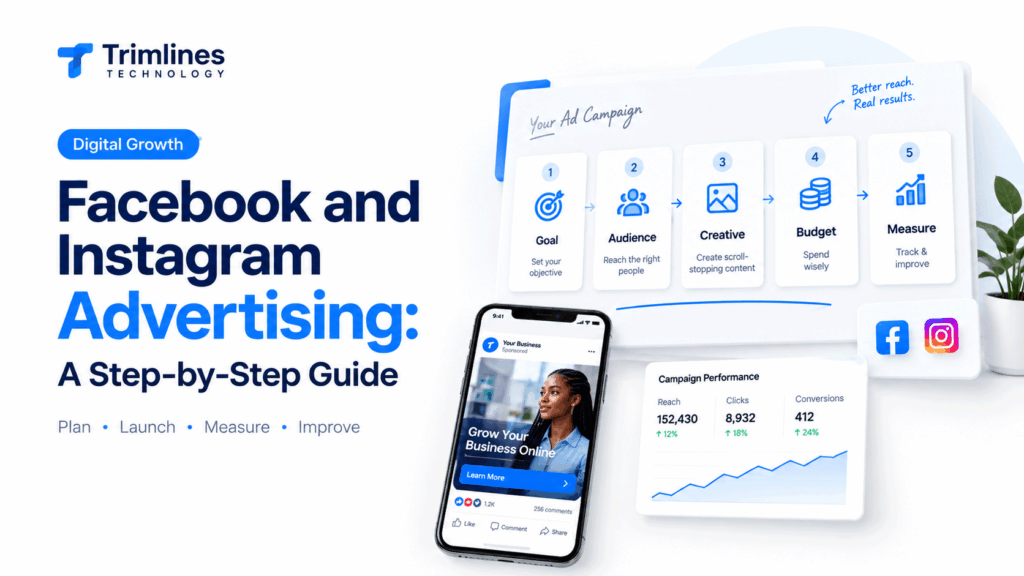
Facebook and Instagram advertising can help businesses reach specific audiences, generate leads, promote products, and drive people to their websites, online stores, or messaging channels.
But effective advertising is more than simply creating a post and putting money behind it.
You need to understand your objective, identify the right audience, create relevant content, manage your budget, and measure what happens after people see or interact with your advert.
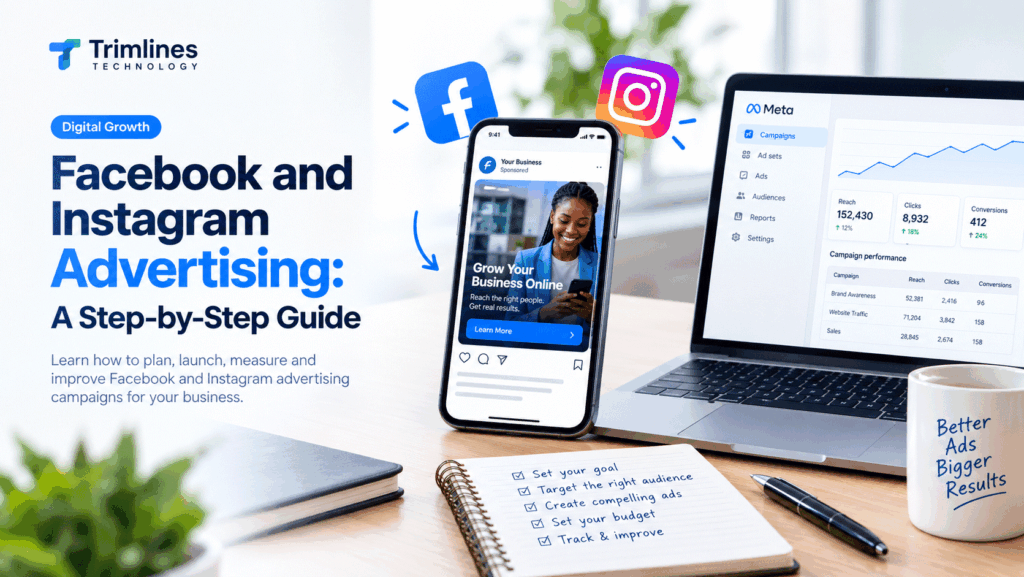
This guide walks through the main steps involved in running Facebook and Instagram advertising campaigns and explains what to consider at each stage.
What Is Facebook and Instagram Advertising?
Facebook and Instagram advertising allows businesses to pay to promote products, services, content, or offers to selected audiences.
Both platforms are part of Meta’s advertising ecosystem, which allows businesses to manage advertising campaigns across Facebook, Instagram, and other available placements.
Instead of showing an advert to everyone, businesses can build campaigns around specific objectives and reach audiences based on factors such as location, demographics, interests, previous interactions, and other available signals.
For example, a business might advertise to:
- People in a particular city or country
- People interested in a particular type of product
- People who have interacted with the business
- People who visited a website
- Existing customers
- Potential customers who share characteristics with an existing audience
The targeting and campaign options available can change over time, so always check the options available in your current Meta advertising account.
Step 1: Define Your Advertising Goal
Before creating an advert, decide exactly what you want the campaign to achieve.
Your goal could be to:
- Generate leads
- Sell products
- Increase website traffic
- Get WhatsApp enquiries
- Promote an app
- Increase awareness
- Generate enquiries for a service
- Encourage people to complete a specific action
Start with this question:
What do I want the customer to do after seeing this advert?
Your campaign objective, advert creative, landing page, and measurement should all support that action.
For example, if you want people to contact your business, your campaign should make contacting you simple.
If you want people to purchase a product, the customer should be taken to a relevant product or shopping experience.
Step 2: Understand Your Target Audience
The more clearly you understand your potential customer, the easier it becomes to create relevant advertising.
Consider:
- Age range
- Location
- Interests
- Buying behaviour
- Occupation or business type
- Problems they are trying to solve
- Products or services they already use
- Where they spend time online
For example, an online fashion store should not simply target everyone interested in fashion.
It should think about the type of customer most likely to purchase its products.
A software company selling business solutions will also approach its audience differently from a restaurant, fashion brand, real estate company, or entertainment business.
The goal is not necessarily to find the largest possible audience.
It is to find people who are relevant to what you are offering.
Step 3: Choose the Right Campaign Objective
Meta provides different campaign objectives depending on the result you want to achieve.
Depending on your current advertising setup, these can include objectives around awareness, traffic, engagement, leads, and sales.
Awareness
Useful when the main purpose is to introduce a business, product, service, or message to more people.
Traffic
Useful when your main goal is to send people to a website, landing page, or another destination.
Engagement
Useful when you want people to interact with your content or business.
Leads
Useful when you want people to submit their information or make an enquiry.
Sales
Useful for businesses focused on purchases and conversions.
The important thing is not to choose an objective simply because it sounds attractive.
Choose the objective that is closest to the actual business result you want.
Step 4: Prepare Your Landing Page
One of the biggest mistakes businesses make is focusing entirely on the advert.
Your advert gets someone’s attention, but the landing page or destination has to continue the customer journey.
Before launching your campaign, check that your website or landing page:
- Loads quickly
- Works properly on mobile
- Clearly explains the offer
- Has a strong headline
- Makes the next step obvious
- Contains accurate contact information
- Makes it easy to purchase or enquire
- Matches the message used in the advert
If an advert promises a particular product or offer but the landing page makes the visitor search for it, you may lose potential customers.
The advert and the landing page should feel like parts of the same experience.
Step 5: Create Your Ad Creative
Your advert needs to communicate its value quickly.
Depending on your campaign, you might use:
- Images
- Short videos
- Carousels
- Product demonstrations
- Customer-focused graphics
- Before-and-after content
- Product photography
- Educational content
Your creative should answer a simple question:
Why should someone stop scrolling and pay attention to this?
Avoid putting too much information into one advert.
A strong creative usually has:
- A clear message
- A relevant visual
- A specific benefit
- A clear call to action
For example, instead of simply saying:
WE BUILD WEBSITES!
A technology company could say:
Need a website that helps your business sell?
The advert can then show examples of the work and provide a clear next step.
Step 6: Write Better Ad Copy
Your copy should be written for the customer, not simply for the business.
Talk about the customer’s problem, desired outcome, or reason for buying.
A simple structure is:
Problem → Solution → Benefit → Action
For example:
Still managing customer enquiries manually?
Our WhatsApp automation solution helps businesses respond faster, answer common questions, and manage customer conversations.
See how it works.
The copy should then lead naturally to the relevant call to action.
Your wording should also match the audience.
A technical explanation might work for developers but confuse a customer who simply wants to understand how your service can help their business.
Step 7: Set Your Audience
Meta provides different ways to define who can see your advertising.
Depending on the campaign, you may work with:
- Location
- Demographics
- Interests
- Behavioural signals
- Custom audiences
- Website visitors
- Existing customers
- People who interacted with your content
Do not make your audience unnecessarily complicated.
If you already have useful customer data, use it to understand who actually converts rather than relying entirely on assumptions.
For a local business, location may be especially important.
If you only deliver within Lagos, for example, advertising across the entire country may not make sense for a campaign focused on local customers.
Step 8: Set Your Budget
Your advertising budget should be connected to your business objective.
You can start with a controlled budget, gather data, and learn from the campaign before increasing your spending.
For example, a business could start with a smaller test budget rather than committing a large amount immediately.
The important thing is to give the campaign enough room to produce useful data.
Do not judge a campaign solely by how many people saw it.
Ask:
- Did people click?
- Did they enquire?
- Did they purchase?
- How much did each lead cost?
- How much revenue did the campaign generate?
A campaign that reaches thousands of people but generates no meaningful business result may need to be reconsidered.
Step 9: Choose Your Placements
Your adverts can potentially appear across different Meta placements depending on your campaign setup.
The appropriate placement depends on your objective and creative.
For example, vertical video may be particularly suitable for mobile-first placements, while a carousel can be useful when you want to display several products.
You do not necessarily need to decide that one placement is always better.
Instead, monitor your campaign data and see where useful results are coming from.
Step 10: Launch the Campaign
Before publishing your campaign, review everything carefully.
Check:
- Campaign objective
- Audience
- Budget
- Schedule
- Ad creative
- Copy
- Destination URL
- Call to action
- Tracking
- Business information
Make sure the link works and that the customer journey works from beginning to end.
A small mistake in a URL, landing page, or checkout process can waste advertising spend.
Step 11: Give the Campaign Time to Produce Data
Once your campaign starts running, avoid making constant changes without enough information.
Give yourself a defined period to evaluate performance.
Watch the metrics that matter for your particular objective.
These can include:
- Reach
- Impressions
- Clicks
- Click-through rate
- Cost per click
- Leads
- Cost per lead
- Purchases
- Conversion rate
- Revenue
- Return on advertising spend
The most important metric depends on what you are trying to achieve.
A campaign designed to generate sales should not be judged only by likes.
Likewise, a campaign designed to increase awareness may use different success measures from a campaign designed to generate purchases.
Step 12: Test Different Creatives
One of the most useful things you can do with paid social advertising is test different versions of your message.
You could test:
- Different headlines
- Different images
- Different videos
- Different calls to action
- Different offers
- Different landing pages
- Different audience approaches
For example:
Ad A: Product-focused image
Ad B: Customer-focused image
Ad C: Short product demonstration video
Instead of guessing which approach will work, compare the results.
Testing should be controlled where possible.
If you change the audience, creative, offer, and landing page at the same time, it becomes harder to understand what caused the difference.
Step 13: Retarget People Who Already Know Your Business
Not everyone who visits your website or interacts with your content will buy immediately.
Retargeting can help businesses reconnect with people who have already interacted with their brand, where the necessary audience data and platform setup are available.
For example, you could create campaigns aimed at people who:
- Visited your website
- Viewed certain products
- Engaged with your social media content
- Watched part of a video
- Started but did not complete an action
The message can also be different from the message shown to someone discovering the business for the first time.
Someone who has already visited your website may need a reminder, additional information, an offer, or another reason to return.
Step 14: Track What Happens After the Click
Getting clicks is not the final goal for most businesses.
You need to understand what happens after someone clicks the advert.
For an e-commerce business:
Ad → Product page → Cart → Checkout → Purchase
For a service business:
Ad → Landing page → Enquiry → Conversation → Customer
If many people click but very few take the next step, the problem may not be the advert.
It could be the:
- Landing page
- Offer
- Pricing
- Trust
- Checkout process
- Sales process
- Follow-up process
This is why advertising should be treated as part of the entire customer journey.
Step 15: Calculate Whether Your Campaign Makes Business Sense
Advertising performance should eventually be connected to business results.
Imagine a business spends $500 on advertising and generates $2,000 in sales.
That does not automatically mean the campaign was profitable.
The business still needs to consider:
- Product cost
- Delivery
- Payment fees
- Staff costs
- Discounts
- Other operating costs
The goal is not simply to generate activity.
The goal is to build a campaign that makes commercial sense.
Common Facebook and Instagram Advertising Mistakes
1. Targeting everyone
A huge audience is not automatically a useful audience.
2. Boosting every post
A post receiving likes organically does not necessarily mean it should receive advertising budget.
3. Using poor creative
People scroll quickly. Your creative needs to communicate its message clearly.
4. Sending everyone to the homepage
Send visitors to the page that is most relevant to the advert.
5. Having no clear call to action
Tell people what you want them to do next.
6. Changing campaigns constantly
Constant changes can make performance difficult to interpret.
7. Measuring only likes
Engagement can be useful, but it is not the same thing as leads, sales, or revenue.
8. Ignoring mobile users
A large portion of social media activity happens on mobile devices, so your creative and landing page should work properly on smaller screens.
9. Not testing
Your first advert is not necessarily your best advert.
10. Not following up with leads
Generating a lead is only the beginning.
Businesses need a process for responding to and converting those enquiries.
How Much Should You Spend on Facebook and Instagram Ads?
There is no single advertising budget that works for every business.
Your budget depends on:
- Your product or service
- Your target market
- Your customer acquisition cost
- Your sales value
- Your conversion rate
- Your available marketing budget
- Your campaign objective
A sensible approach for many businesses is to start with a controlled test, measure the results, improve the campaign, and then decide whether additional spending makes sense.
The amount you spend should also be realistic for your business.
Do not spend money simply because you feel you need to “run an advert.”
Know what you are trying to learn or achieve with the campaign.
Facebook and Instagram Advertising for Nigerian Businesses
For businesses in Nigeria, paid social advertising can be useful for reaching customers within specific cities, regions, or broader markets.
However, local businesses should consider more than simply targeting Nigeria.
A Lagos-based business, for example, may have a very different target customer from a business selling nationwide.
Your campaign should reflect:
- Where you actually serve customers
- Your delivery coverage
- Your pricing
- Your customer demographics
- The language and messaging your audience understands
- How customers prefer to contact you
For some businesses, the best conversion may happen through a website.
For others, a WhatsApp conversation, phone call, lead form, or direct enquiry may be more appropriate.
The important thing is to make the next step easy for the customer.
Should You Advertise on Facebook, Instagram, or Both?
There is no universal answer.
The right choice depends on your audience, creative, objective, and campaign data.
Some businesses may find that their customers engage more with Instagram content, while others may get stronger results through Facebook or a combination of placements.
Instead of choosing based only on assumptions, use campaign data to understand where your results are coming from.
When Should You Use a Marketing Professional?
You can learn the basics of running Meta advertising yourself, but managing campaigns effectively can become more complex as your business grows.
Professional help can be useful when you need:
- Multiple campaigns
- Conversion tracking
- E-commerce advertising
- Lead generation systems
- Retargeting
- Landing pages
- Creative testing
- Analytics
- Campaign optimization
- Integration with your CRM or business systems
Advertising is only one part of digital growth.
Your website, content, sales process, customer support, and technology all contribute to the final result.
Want Help With Your Facebook & Instagram Ads?
Whether you need a practical walkthrough, professional advertising support, or training for your team, Trimlines Technology can help you put your advertising strategy into practice.
Final Thoughts
Facebook and Instagram advertising can be a useful part of a digital marketing strategy, but successful advertising is more than pressing the “Boost” button.
Start with a clear business goal.
Understand your audience.
Create relevant advertising.
Send people to a useful destination.
Track what happens.
Test different approaches.
Then use the data to improve the campaign.
The biggest advantage of paid advertising is not simply the ability to reach more people. It is the ability to learn which audiences, messages, offers, and customer journeys produce meaningful business results.
For businesses that want to grow online, paid advertising works best when it is connected to a broader digital strategy rather than treated as a standalone activity.